
TB-500, also known by its full name Thymosin Beta-4, is one of the most actively studied synthetic peptides in modern research contexts. Appearing in thousands of peer-reviewed publications across the last two decades, this 43-amino acid peptide has drawn significant scientific interest for the pathways it appears to interact with at the cellular level.
This overview is intended for laboratory researchers and scientific professionals exploring TB-500 for in vitro applications.
Disclaimer: All information in this article pertains to in vitro research and laboratory study only. TB-500 and all products referenced are not approved for human or animal administration, medical therapy, or diagnostic use.
What Is TB-500?
TB-500 is a synthetic version of Thymosin Beta-4 (Tβ4), a naturally occurring peptide encoded by the TMSB4X gene. It is part of the beta-thymosin family — small, acidic peptides that play a structural and regulatory role at the cellular level.
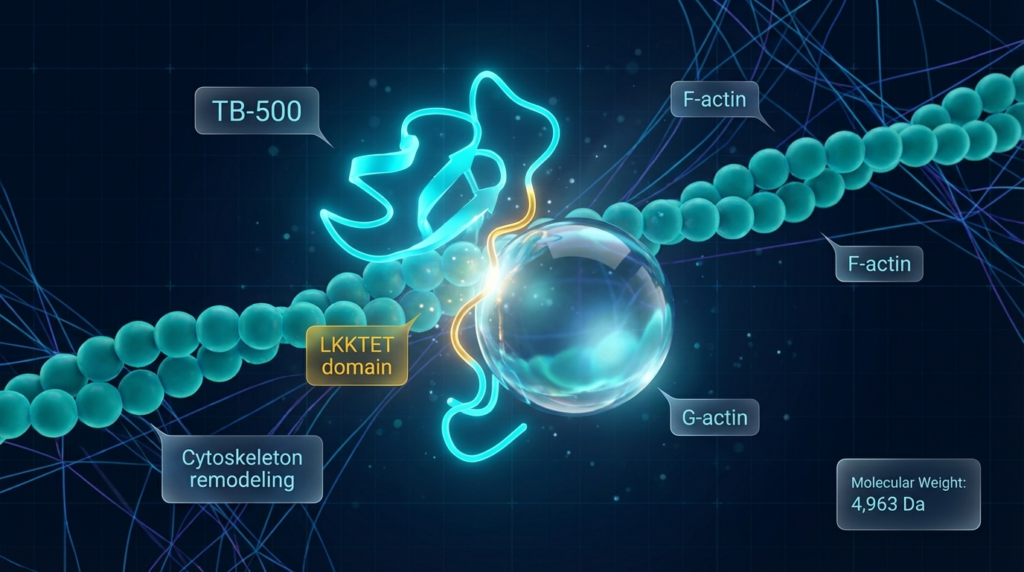
The molecule’s primary characteristic that has drawn research interest is its interaction with actin, a protein central to cell structure, motility, and signaling. Specifically, TB-500 contains an actin-binding domain (the LKKTET sequence) that allows it to sequester G-actin monomers, influencing the dynamics of the actin cytoskeleton.
This mechanism has made TB-500 a subject of intense laboratory interest across multiple research disciplines.
Molecular Structure and Properties
| Property | Detail |
|---|---|
| Full name | Thymosin Beta-4 |
| Amino acid sequence | 43 amino acids |
| Molecular weight | ~4,963 Da |
| Solubility | Water-soluble |
| CAS Number | 77591-33-4 |
| Storage | Lyophilized powder; store at -20°C |
TB-500’s relatively small molecular weight and high water solubility make it amenable to a range of in vitro experimental conditions. It retains structural stability under common laboratory storage conditions when lyophilized.
What Research Has Explored With TB-500
Scientific literature involving TB-500 has examined several areas of biological interest. The following reflects themes found in published in vitro and animal model research — not clinical outcomes or therapeutic use.
1. Actin Dynamics and Cell Motility
The most well-documented area of TB-500 research involves its role in actin regulation. Studies have explored how the peptide affects G-actin sequestration, cytoskeletal reorganization, and downstream effects on cell migration. This makes it particularly relevant for research into wound healing biology and tissue repair mechanisms at the cellular level.
2. Angiogenesis Pathways
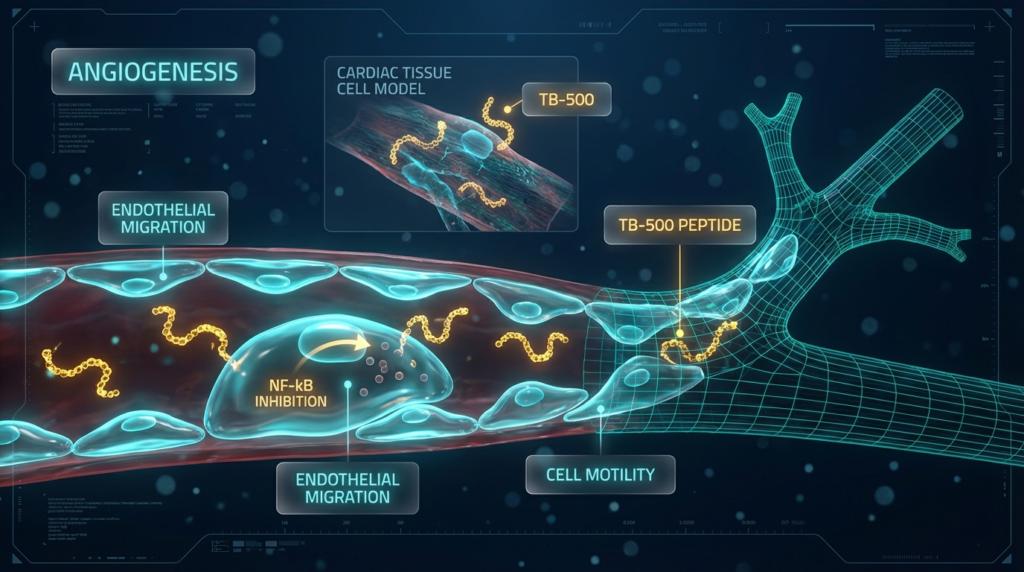
Multiple published studies have examined TB-500’s apparent influence on angiogenesis — the formation of new blood vessels from existing vasculature. In vitro models have explored how it interacts with endothelial cell migration and tube formation, making it of interest in cardiovascular and vascular biology research.
3. Inflammatory Response Modulation
TB-500 has appeared in research examining its effects on inflammatory pathway regulation. Some in vitro studies suggest it may interact with NF-kB signaling and cytokine expression profiles, though this remains an active and evolving area of inquiry.
4. Cardiac and Neurological Research
More recent literature has explored Thymosin Beta-4 in cardiac recovery models and neuroprogenitor cell studies. These represent emerging research directions that continue to generate peer-reviewed publication interest.
TB-500 vs. BPC-157: Understanding the Research Distinction
Researchers frequently study TB-500 alongside BPC-157, another peptide with significant literature presence. While often studied in combination (as in the “Wolverine Stack” in research circles), they interact with different primary mechanisms:
- TB-500 primarily interacts with the actin cytoskeleton and appears in research on cell motility, angiogenesis, and tissue-level repair modeling.
- BPC-157 is a synthetic peptide derived from Body Protection Compound, with research interest centered on gastric mucosa protection, tendon and ligament repair models, and nitric oxide pathway interactions.
In combined in vitro and animal model research, these two peptides are often studied together to observe potential complementary effects across overlapping biological pathways.
Sourcing Considerations for Researchers
For laboratory research, peptide purity is a critical variable that directly affects experimental validity. When sourcing TB-500 for research applications, key quality indicators include:
- Purity certification: Look for compounds validated at >99% purity via HPLC and mass spectrometry
- Certificate of Analysis (CoA): Batch-specific documentation ensuring compound identity and purity
- Manufacturing standards: USA-manufactured compounds offer consistency and traceability
- Proper storage and handling documentation
At Molecular Edge Peptides, our TB-500 is synthesized to exceed 99% purity and validated by both HPLC and mass spectrometry, with batch verification on every production run. Our compounds are manufactured in the USA and formulated exclusively for laboratory research applications.
Key Takeaways for Research Planning
- TB-500 is a 43-amino acid synthetic peptide studied extensively for its actin-binding and angiogenic properties in vitro
- Its primary research interest lies in cell motility, tissue repair modeling, and vascular biology
- It is frequently studied in combination with BPC-157 for overlapping pathway investigation
- Purity and batch verification are critical considerations when selecting a research supplier
- All TB-500 research is conducted under in vitro or controlled animal model conditions — it is not approved for human or clinical use
Explore TB-500 for Your Research
Molecular Edge Peptides supplies research-grade TB-500 synthesized to exceed 99% purity, HPLC and mass spectrometry verified, and manufactured in the USA. Free shipping is available on orders over $250.
View TB-500 in the Molecular Edge Catalog →
All products sold by Molecular Edge Peptides are strictly intended for laboratory research use only and are not approved for human or animal consumption or any therapeutic use.