TL;DR: GHK-Cu (glycyl-L-histidyl-L-lysine copper complex) is a naturally occurring tripeptide first isolated from human plasma by Loren Pickart. GHK-Cu research demonstrates modulation of 4,000+ human genes, MMP/TIMP balance regulation, collagen I and III synthesis stimulation, and extracellular matrix remodeling activity across multiple in vitro and preclinical models. This compound remains one of the most extensively studied copper peptides in tissue remodeling research.
Table of Contents
- What Is GHK-Cu and Why Does It Matter in Peptide Research?
- How Was GHK-Cu Discovered? The Pickart Research Timeline
- How Does GHK-Cu Modulate the MMP/TIMP Balance in Extracellular Matrix Remodeling?
- What Does GHK-Cu Research Reveal About Collagen Synthesis and Gene Expression?
- GHK-Cu Gene Regulation Data – Key Pathways and Expression Changes
- What Role Does Copper Coordination Play in GHK-Cu Research?
- How Does GHK-Cu Compare to Other Peptides Studied for Tissue Remodeling?
- GHK-Cu Compound Specifications
- Frequently Asked Questions About GHK-Cu Research
- References
What Is GHK-Cu and Why Does It Matter in Peptide Research?
GHK-Cu (glycyl-L-histidyl-L-lysine:copper(II)) is a naturally occurring tripeptide-copper complex found in human plasma, saliva, and urine. The compound consists of three amino acids – glycine, histidine, and lysine – coordinated with a copper(II) ion through nitrogen atoms in the peptide backbone and the histidine imidazole ring.
GHK-Cu research has attracted significant attention in molecular biology because of the compound’s documented interactions with extracellular matrix components, metalloproteinase systems, and large-scale gene expression networks. Plasma concentrations of the free GHK tripeptide decline with age, dropping from approximately 200 ng/mL at age 20 to roughly 80 ng/mL by age 60. [2]
As a Research Use Only (RUO) compound, GHK-Cu serves as a valuable tool for in vitro investigations into tissue remodeling mechanisms, collagen biosynthesis pathways, and copper-dependent signaling cascades. The compound’s molecular weight of approximately 403.9 Da places it within the range relevant to the 500 Dalton rule in transdermal peptide research.
How Was GHK-Cu Discovered? The Pickart Research Timeline
Loren Pickart first identified the GHK sequence in 1973 during his doctoral research at the University of California, San Francisco. Pickart observed that albumin from young human blood promoted hepatocyte survival and proliferation in culture at higher rates than albumin from older donors. Subsequent fractionation work isolated the active component as the tripeptide glycyl-L-histidyl-L-lysine.
In 1980, Pickart and colleagues published findings demonstrating that GHK functions by facilitating copper uptake into cells, establishing the copper coordination as central to the tripeptide’s biological activity. [2] This discovery positioned GHK-Cu at the intersection of copper biology and peptide biochemistry.
The research timeline expanded significantly when Pickart’s group utilized the Broad Institute Connectivity Map (CMap) database to profile GHK’s gene expression effects. Their 2014 analysis revealed that GHK modulates the expression of over 4,000 human genes, approximately 31.2% of the human genome. [1] This study remains the most comprehensive gene expression profiling of any single peptide compound in the research literature.
How Does GHK-Cu Modulate the MMP/TIMP Balance in Extracellular Matrix Remodeling?
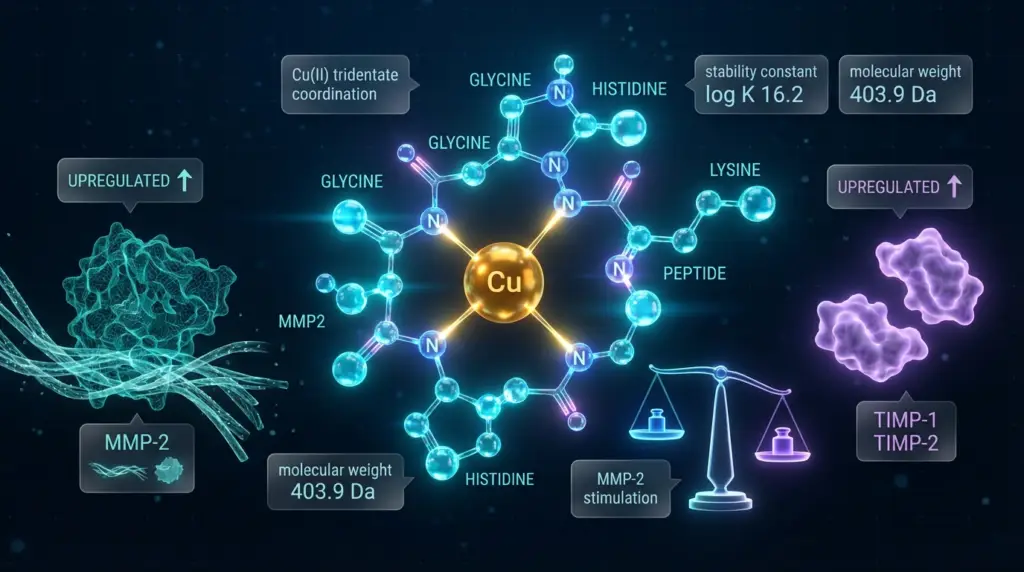
GHK-Cu simultaneously upregulates matrix metalloproteinase-2 (MMP-2) expression and increases tissue inhibitor of metalloproteinases (TIMP-1 and TIMP-2) secretion in fibroblast cultures. This dual regulation enables coordinated extracellular matrix turnover rather than uncontrolled degradation. [4]
The MMP/TIMP balance is critical for tissue remodeling. MMPs break down existing extracellular matrix components to allow new tissue formation, while TIMPs prevent excessive degradation. In vitro studies by Simeon, Emonard, Hornebeck, and Maquart demonstrated that GHK-Cu increased MMP-2 mRNA levels in dermal fibroblast cultures while simultaneously elevating TIMP-1 and TIMP-2 secretion. [4] The copper ion component proved essential for MMP-2 stimulation – the GHK tripeptide alone did not produce this effect.
This coordinated MMP/TIMP modulation distinguishes GHK-Cu research from studies on compounds that activate only degradation or only synthesis pathways. The resulting balanced remodeling cascade has been studied extensively in wound healing models where both matrix clearance and new matrix deposition are required.
What Does GHK-Cu Research Reveal About Collagen Synthesis and Gene Expression?
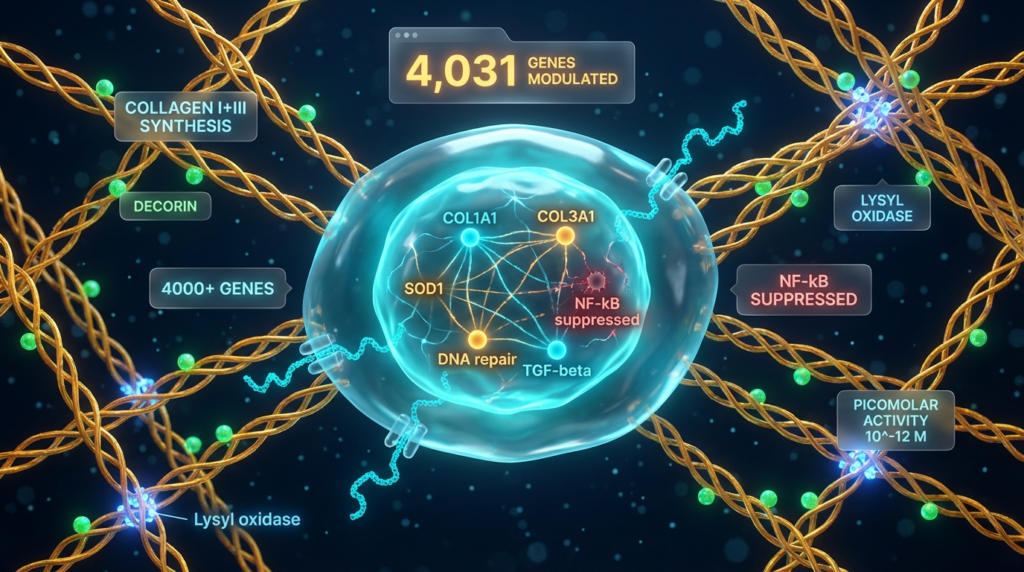
GHK-Cu stimulates collagen synthesis in fibroblast cultures at concentrations as low as 10^-12 M, with maximal stimulation observed at 10^-9 M, independent of changes in cell number. [5] This finding, published by Maquart and colleagues in 1988, established the picomolar-to-nanomolar activity range of GHK-Cu in collagen biosynthesis.
The collagen synthesis data encompasses both type I and type III collagen, the two primary fibrillar collagens in connective tissue. GHK-Cu also stimulates decorin synthesis, a small leucine-rich proteoglycan that regulates collagen fibril assembly and spacing. [6] The combined upregulation of collagens and decorin indicates that GHK-Cu promotes organized rather than disordered matrix deposition.
Research into combined peptide protocols has examined how GHK-Cu interacts with other matrix-active compounds. Studies exploring the stacking of BPC-157 and GHK-Cu for collagen synthesis have documented complementary mechanisms where BPC-157 targets angiogenesis pathways while GHK-Cu drives direct matrix component production.
Beyond direct collagen production, Pickart’s Connectivity Map analysis identified GHK-driven upregulation of genes encoding collagen types I, III, and V, plus fibronectin, laminin, and multiple glycosaminoglycan synthesis enzymes. [1] The breadth of extracellular matrix gene activation observed in these profiling studies exceeds what any single growth factor has demonstrated.
GHK-Cu Gene Regulation Data – Key Pathways and Expression Changes
The following table summarizes the major gene expression pathways modulated by GHK-Cu, as documented through Connectivity Map analysis and in vitro gene profiling studies. [1] [3]
| Pathway Category | Direction | Number of Genes | Key Examples |
|---|---|---|---|
| Collagen and ECM synthesis | Upregulated | 47 | COL1A1, COL3A1, COL5A1, FN1, DCN |
| Matrix metalloproteinases | Upregulated | 8 | MMP2, MMP9, MMP11 |
| TIMP (metalloproteinase inhibitors) | Upregulated | 5 | TIMP1, TIMP2 |
| Antioxidant response | Upregulated | 14 | SOD1, SOD2, SOD3, GPX1 |
| DNA repair | Upregulated | 47 | GADD45A, XPC, ERCC1 |
| Ubiquitin-proteasome system | Upregulated | 41 | Multiple UPS genes |
| TGF-beta superfamily | Upregulated | 33 | TGFB1, BMP2, BMP4, SMAD signaling |
| Pro-inflammatory (NF-kB) | Suppressed | 32 | IL-6, TNF-alpha pathway genes |
| Fibrinogen synthesis | Suppressed | 3 | FGA, FGB, FGG |
| Insulin/IGF-related | Modulated | 89 | Complex bidirectional regulation |
This gene regulation profile positions GHK-Cu research at the center of multiple intersecting biological networks. The simultaneous activation of repair pathways and suppression of inflammatory and fibrotic pathways represents a unique regulatory signature not observed with other single peptide compounds studied to date.
What Role Does Copper Coordination Play in GHK-Cu Research?
The copper(II) ion in GHK-Cu is not a passive structural element – it is functionally essential for the compound’s matrix-remodeling activity. Simeon et al. demonstrated that the GHK tripeptide without copper coordination failed to stimulate MMP-2 expression, while copper ions alone partially reproduced the effect. [4] The complete GHK-Cu complex produced the strongest and most consistent fibroblast response.
Copper coordination occurs through the alpha-amino nitrogen of glycine, the amide nitrogen of the Gly-His peptide bond, and the imidazole nitrogen of the histidine side chain. This tridentate binding creates a square-planar coordination geometry around the copper center, with a stability constant (log K) of approximately 16.2 at physiological pH.
The copper delivery function also connects to broader metallobiochemistry. GHK-Cu serves as a mobile copper transport complex, delivering Cu(II) to cells through a mechanism that bypasses standard copper transporter proteins. This copper delivery capacity explains the compound’s influence on copper-dependent enzymes including lysyl oxidase (required for collagen crosslinking), superoxide dismutase (SOD), and cytochrome c oxidase. [3]
How Does GHK-Cu Compare to Other Peptides Studied for Tissue Remodeling?
GHK-Cu occupies a distinct position in the peptide research landscape due to its combined gene regulatory scope and direct matrix synthesis activity. While growth factors like TGF-beta and FGF-2 each modulate hundreds of genes, GHK-Cu’s documented influence on 4,000+ genes represents an order of magnitude greater regulatory breadth. [1]
In wound healing research models, GHK-Cu stimulates both synthesis and breakdown of collagen and glycosaminoglycans, modulates metalloproteinase/inhibitor ratios, attracts immune and endothelial cells, and promotes angiogenesis and nerve outgrowth. [6] In vitro studies combining GHK-Cu with LED photoirradiation demonstrated enhanced type I collagen mRNA expression (approximately 70% increase) and procollagen type I C-peptide production (approximately 30% increase) compared to LED treatment alone. [7]
Researchers investigating tissue regeneration protocols often study GHK-Cu alongside compounds such as BPC-157, which targets distinct but complementary wound healing pathways involving VEGF and NO-mediated angiogenesis.
For a comprehensive overview of current peptide research protocols and compound classifications, the 2026 Master Index of Peptide Research Protocols provides an organized hub of peer-reviewed references and laboratory standards.
GHK-Cu Compound Specifications
| Specification | Detail |
|---|---|
| Full Chemical Name | Glycyl-L-histidyl-L-lysine:copper(II) |
| Sequence | Gly-His-Lys-Cu(II) |
| Molecular Formula | C14H24CuN6O4 |
| Molecular Weight | 403.9 Da |
| CAS Number | 49557-75-7 |
| Natural Source | Human plasma, saliva, urine |
| Copper Binding Constant (log K) | ~16.2 at physiological pH |
| Optimal Activity Range (in vitro) | 10^-12 to 10^-9 M |
| Classification | Research Use Only (RUO) |
| Storage | Lyophilized, -20C, desiccated |
Molecular Edge Peptides supplies research-grade GHK-Cu at 99% purity with full Certificate of Analysis documentation – HPLC chromatogram and mass spectrometry data included – for qualified in vitro laboratory research use exclusively. GHK-Cu is also available as part of the KLOW Blend (BPC-157 + TB-500 + KPV + GHK-Cu) for multi-target research protocols.
Frequently Asked Questions About GHK-Cu Research
What is GHK-Cu and what does the research literature examine?
GHK-Cu is glycyl-L-histidyl-L-lysine coordinated with a copper(II) ion. The research literature examines its role in extracellular matrix remodeling, collagen synthesis, metalloproteinase regulation, gene expression modulation, and copper delivery to cells. First identified by Loren Pickart in 1973, GHK-Cu has been the subject of hundreds of published studies across tissue biology, wound healing models, and gene profiling datasets. It is classified as a Research Use Only compound for in vitro laboratory investigation.
How many human genes does GHK-Cu modulate according to published research?
Connectivity Map (CMap) analysis by Pickart, Vasquez-Soltero, and Margolina identified GHK as influencing the expression of over 4,000 human genes, representing approximately 31.2% of the human genome. [1] Gene categories affected include collagen synthesis, antioxidant defense, DNA repair, ubiquitin-proteasome clearance, TGF-beta signaling, and suppression of NF-kB-mediated inflammatory pathways.
What is the MMP/TIMP balance and why is it relevant to GHK-Cu research?
The MMP/TIMP balance refers to the ratio between matrix metalloproteinases (which degrade extracellular matrix) and tissue inhibitors of metalloproteinases (which prevent excessive degradation). GHK-Cu simultaneously increases MMP-2 expression and TIMP-1/TIMP-2 secretion, enabling coordinated matrix turnover. [4] This dual regulation is essential for tissue remodeling where controlled degradation and rebuilding must occur in parallel.
What collagen types are affected by GHK-Cu in in vitro studies?
GHK-Cu stimulates synthesis of type I, type III, and type V collagen in fibroblast culture models. [5] [1] It also increases decorin production, a proteoglycan that organizes collagen fibril assembly. The combined upregulation of multiple collagen types plus decorin indicates promotion of structured, organized matrix formation rather than disordered fibrotic deposition.
Why is the copper ion essential for GHK-Cu activity in research models?
The copper(II) ion provides the functional signaling component through tridentate coordination with the GHK peptide backbone. Studies show that GHK without copper failed to stimulate MMP-2 expression, while the complete GHK-Cu complex produced maximum fibroblast response. [4] Copper also activates downstream metalloenzymes including lysyl oxidase for collagen crosslinking and superoxide dismutase for antioxidant defense.
How does GHK-Cu research relate to other peptide compounds studied for tissue remodeling?
GHK-Cu targets extracellular matrix synthesis and metalloproteinase regulation through direct gene expression modulation, while peptides like BPC-157 operate through VEGF-mediated angiogenesis pathways. Researchers often study these compounds in combination to investigate multi-target approaches. GHK-Cu’s unique gene regulatory scope of 4,000+ genes distinguishes it from single-pathway compounds in the current research literature. For additional context, see the research-grade synthetic peptide catalog at Molecular Edge Peptides.
Disclaimer: All products sold by Molecular Edge Peptides are strictly intended for laboratory research use only (in vitro). They are not approved for human or animal consumption, or for any form of therapeutic, diagnostic, or clinical use. The information in this article is for educational and scientific reference purposes only. We do not provide usage instructions, dosing guidelines, or any advice regarding personal application of our products. Always consult relevant regulatory frameworks before conducting research with these compounds.
References
- Pickart L, Vasquez-Soltero JM, Margolina A. “GHK and DNA: Resetting the Human Genome to Health.” BioMed Res Int. 2014;2014:151479. PubMed: 25302294
- Pickart L. “The Human Tri-Peptide GHK and Tissue Remodeling.” J Biomater Sci Polym Ed. 2008;19(8):969-988. PubMed: 18644225
- Pickart L, Margolina A. “Regenerative and Protective Actions of the GHK-Cu Peptide in the Light of the New Gene Data.” Int J Mol Sci. 2018;19(7):1987. PubMed: 29986520
- Simeon A, Emonard H, Hornebeck W, Maquart FX. “The Tripeptide-Copper Complex Glycyl-L-Histidyl-L-Lysine-Cu2+ Stimulates Matrix Metalloproteinase-2 Expression by Fibroblast Cultures.” Life Sci. 2000;67(18):2257-2265. PubMed: 11045606
- Maquart FX, Pickart L, Laurent M, Gillery P, Monboisse JC, Borel JP. “Stimulation of Collagen Synthesis in Fibroblast Cultures by the Tripeptide-Copper Complex Glycyl-L-Histidyl-L-Lysine-Cu2+.” FEBS Lett. 1988;238(2):343-346. PubMed: 3169264
- Pickart L, Margolina A. “GHK Peptide as a Natural Modulator of Multiple Cellular Pathways in Skin Regeneration.” Biomed Res Int. 2015;2015:648108. PubMed: 26236730
- Park JR, Lee HN, Kim BJ, Kim MN. “In Vitro Observations on the Influence of Copper Peptide Aids for the LED Photoirradiation of Fibroblast Collagen Synthesis.” Photomed Laser Surg. 2007;25(2):124-131. PubMed: 17603859