
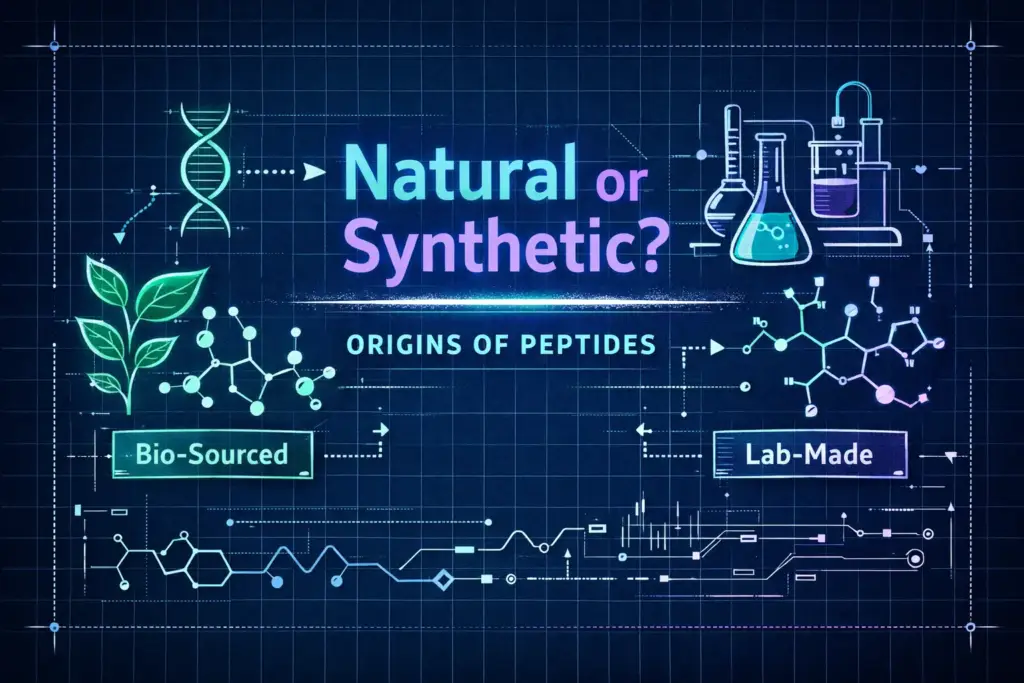
Are peptides natural? Yes. The body synthesizes thousands of endogenous peptides, and researchers have catalogued more than 7,000 distinct sequences that act as biological signals. These short chains function in roles ranging from hormone signaling to antimicrobial defense and tissue repair.
This article compares peptides and proteins, describes typical peptide length and rapid turnover by peptidases, and contrasts food-derived or collagen peptides with sequences designed for pharmacological research. You will learn to distinguish dietary and supplement peptides from synthetic standards and to apply that distinction to assay design, claims and experimental choices. Endogenous peptides are active signals, not inert fragments, and that fact affects reagent selection and data interpretation in both basic and translational work.
Key takeaways
- Peptides occur naturally in cells; thousands of distinct sequences act as signaling molecules. Many of these are short receptor-binding sequences that operate quickly and locally.
- Compared with larger proteins, peptides turnover faster and tend to engage receptors directly. Treat them as active signaling molecules rather than inert fragments when designing experiments.
- Peptides are present in food, but digestion and molecular size limit how many reach the circulation intact. Do not assume systemic bioavailability in research models without clinical evidence for the specific sequence and formulation.
- For reproducible assays, use synthesized peptides that come with analytical validation and a certificate of analysis. Aim for very high purity in quantitative workflows to reduce confounding peaks and variability.
- Ask suppliers for lot traceability, handling guidance and analytical data; poor documentation or low purity can undermine quantitative work. Verify a CoA against the physical lot before using material in critical experiments.
Are peptides natural: how your body makes them
Cells produce endogenous peptides either constitutively or in response to specific signals, and many tissues release sequences that act locally or systemically. Proteolytic processing of larger precursor proteins, regulated secretion and tissue-specific expression together generate a broad peptide repertoire present in blood and extracellular fluids. Functional classes include hormones, neuropeptides, antimicrobial peptides and repair factors; examples include insulin and glucagon for glucose regulation and ghrelin for metabolic signaling.
Signaling peptides are typically short, often between two and about twenty amino acids, and they are cleared rapidly by peptidases. Their short length favors direct receptor engagement rather than structural assembly, so they act as potent but transient signals. Those kinetic and recognition properties influence assay timing and dictate stability and delivery strategies when investigating peptides in pre-clinical drug discovery models or experimental reagents.
- Eggs, meat and fish: Proteolysis during cooking and digestion generates fragments with antimicrobial or antioxidant activity in vitro. Whether those fragments reach the circulation intact depends on their size and the gut barrier.
- Legumes and soy: Fermentation and enzymatic processing increase peptide yield and diversity, producing sequences that may act locally in the gut. Their systemic impact is usually limited by digestion unless specifically formulated to enhance absorption.
- Collagen hydrolysates: Industrial hydrolysis produces short collagen peptides studied in nutritional biochemistry for their potential in connective tissue models. Research literature indicates bioactive potential within controlled study parameters, observing changes in markers related to structural protein synthesis and tissue integrity, though mechanisms differ across products.
Absorption and systemic activity depend on sequence, molecular size and the surrounding matrix. Some food-derived peptides are absorbed intact and show modest systemic effects, but many are degraded or act only within the gut. Concentration, formulation, and experimental duration determine whether a dietary peptide delivers systemic activity — a topic discussed in more detail in a review of food-derived bioactive peptides.
Why labs synthesize peptides and how synthetic versions differ
Laboratories synthesize peptides when the native sequence is absent or impractical to isolate, or when precise control over sequence and chemical modifications is required. Solid-phase peptide synthesis (SPPS) is the standard method because it allows stepwise assembly and incorporation of defined modifications. For a practical primer on SPPS workflows and considerations, consult this overview of peptide synthesis methods. After synthesis, peptides are cleaved from resin, purified by preparative HPLC and verified by analytical HPLC and mass spectrometry before release with a certificate of analysis.
Typical impurities include incomplete couplings, deletion sequences, scrambled products and oxidation of sensitive residues; these appear as extra peaks in LC-MS. Such impurities can distort concentration estimates and introduce off-target activity or cytotoxic signals in cell-based assays. Careful purification and analytical validation are essential to avoid misleading results and to ensure accurate concentration-response interpretation. Practical approaches to peptide isolation and purification are reviewed in industry primers on peptide isolation techniques.
Chemists modify peptides to meet assay or therapeutic goals such as increased plasma half-life, improved membrane penetration or altered receptor signaling. Common strategies include amino acid substitutions that resist proteolysis, lipidation for membrane or topical delivery, PEGylation to extend circulation and stapling to stabilize secondary structure. Synthesis also permits noncanonical residues, isotopic labels and conjugation handles, features that native sequences typically lack and that improve detection and reproducibility in analytical workflows.
Purity, reproducibility, and choosing reliable peptide suppliers
Reagent quality is a common hidden variable when experiments fail to replicate. Impurities change effective concentration, shift concentration-response curves and introduce cytotoxic components that mask intended biology. A contaminated lot with a truncated peptide, for example, can activate cell stress pathways and yield false positives in proliferation assays, wasting time and resources on follow-up work.
Before placing an order, request a minimal documentation package so your assays start from a reproducible baseline. At minimum, ask for the items below and verify that analytical data match the physical lot.
- Certificate of analysis (CoA) with an analytical HPLC chromatogram and peptide mass spectrometry data. The CoA should show the preparative and analytical profiles that confirm identity and purity of the declared sequence.
- Declared purity and target: aim for greater than 99% purity for analytical or quantitative workflows. Higher purity reduces confounding peaks and supports accurate quantification for publication or regulatory submissions.
- Lot traceability and manufacturing date. Lot-level documentation lets you trace performance issues back to a specific batch and assess storage time and stability.
- Endotoxin and microbial testing when peptides will be used in cell culture. Confirm acceptable endotoxin thresholds and the methods used for testing to avoid misleading cell-based results.
- Reconstitution notes and recommended solvents for assay integration. Proper solvent instructions and stability after thawing reduce variability at the bench. For hands-on guidance, refer to thePrecision Reconstitution: A Technical Guide to Peptide Solution Preparation.
Verify that the CoA matches the physical lot you receive; mismatches are a frequent source of reproducibility problems. If analytical documentation is incomplete, delay critical experiments until you have verified identity and purity.
Choose suppliers that document analytical validation and provide technical support for integrating peptides into your workflow. Molecular Edge Peptides manufactures in the U.S., validates each batch by HPLC and mass spectrometry, supplies a CoA with every order and provides reconstitution guidance and expedited options for qualified labs. Use technical consultation to align peptide form, purity and storage with assay constraints and regulatory needs.
Are peptides natural: practical takeaways for researchers
Laboratories synthesize peptides to obtain reproducible material with a defined sequence, consistent purity and complete documentation that natural sources cannot reliably provide. Use validated synthetic peptides with analytical verification by HPLC and mass spectrometry when you need consistent controls, standards or mechanistic probes.
For further curated resources on protocols, standards and methodological references relevant to peptide research, consult The Master Index of Peptide Research.
ALL ARTICLES AND PRODUCT INFORMATION PROVIDED ON THIS WEBSITE ARE FOR INFORMATIONAL AND EDUCATIONAL PURPOSES ONLY. The products offered on this website are furnished for in-vitro laboratory studies only. These products are not medicines or drugs and have not been approved by the FDA to prevent, treat, or cure any medical condition. Any mention of “bioactivity” or “efficacy” refers to observations within experimental research models and not human clinical outcomes.