
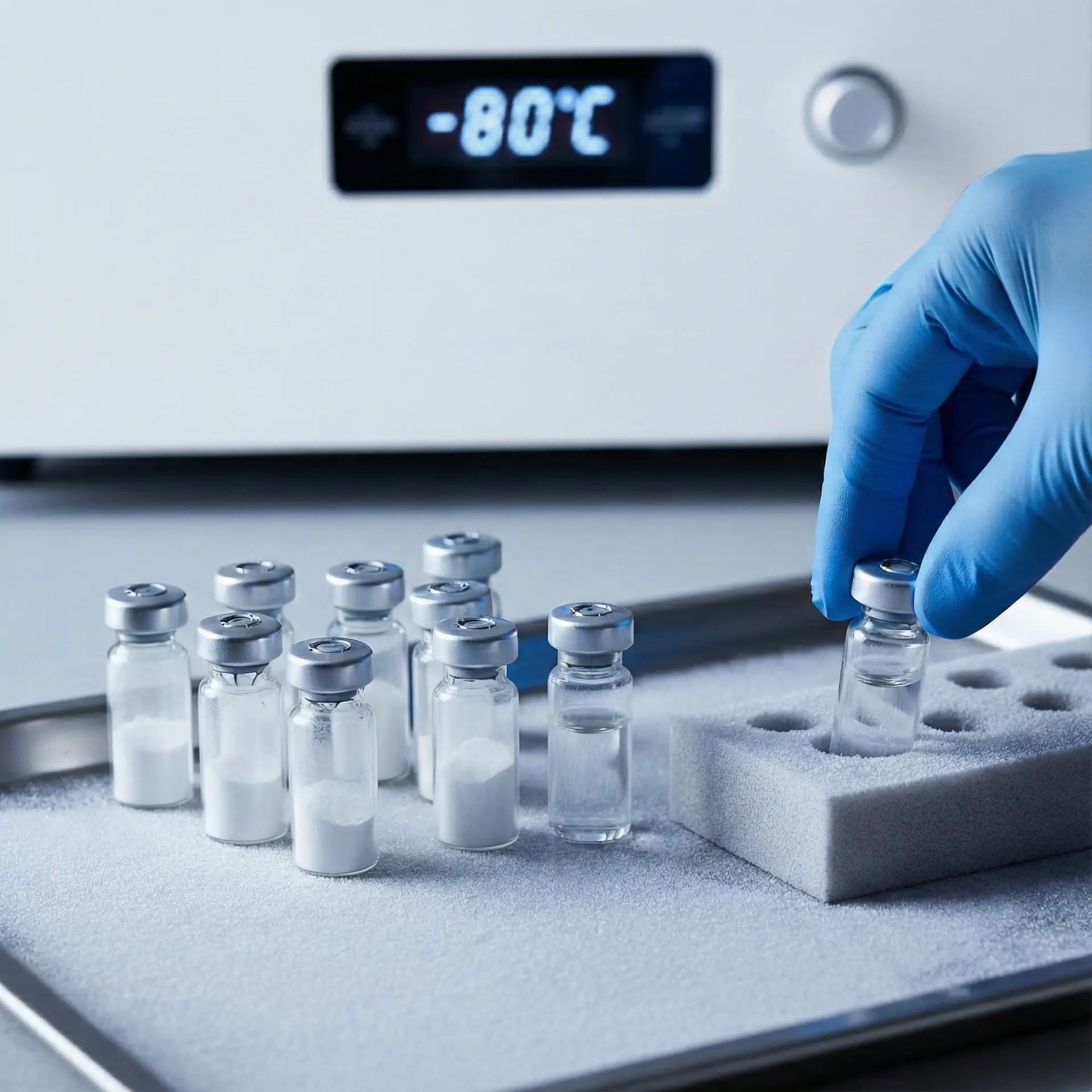
To preserve the integrity of your laboratory results, the proper storage of peptides is absolutely essential. Correct handling ensures that peptides remain stable for years, guarding against oxidation and degradation that could otherwise render your peptides useless for experimentation. While stability can vary based on composition, knowing the best practices for storing peptides will significantly extend their shelf life and reliability.
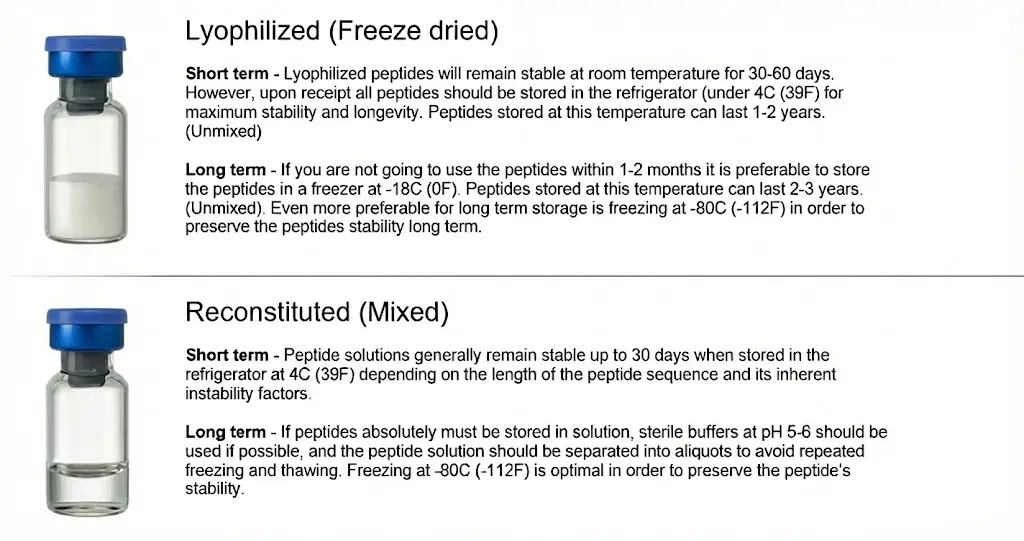
Once you receive a shipment, it is strictly necessary to keep the peptides cold and protected from light. If you plan to use them within the next few days or weeks, refrigerating your peptides at 4°C (39°F) is generally acceptable. Lyophilized peptides are actually quite stable at room temperature for short periods, so this approach is often adequate for immediate use.
However, for long-term storage lasting months or years, it is far better to keep peptides in a freezer at -80°C (-112°F). Deep freezing is the optimal method for preserving the structural integrity of peptides over time.
Finally, be sure to avoid repeated freeze-thaw cycles, as this dramatically increases susceptibility to degradation. You should also avoid using frost-free freezers to store peptides, as the temperature fluctuations during automatic defrost cycles can easily cause damage.
Preventing Oxidation and Moisture Contamination
To ensure your research yields accurate results, maintaining peptide stability is crucial. Peptides are sensitive biological molecules that can easily degrade if exposed to improper conditions. Follow these three essential steps to protect your peptides from air, moisture, and oxidation.
1. Prevent Moisture Contamination Moisture is the number one enemy of lyophilized peptides. When you remove a vial from the freezer, the temperature difference can cause condensation to form on the peptide or inside the container.
- Tip: Always allow the peptide vial to reach room temperature before opening. This simple step prevents hygroscopic uptake (absorbing moisture from the air).
2. Minimize Exposure to Air (Oxidation) Oxidation can ruin the integrity of your sample, especially for peptides containing Cysteine (C), Methionine (M), or Tryptophan (W).
- Best Practice: Keep the container sealed whenever possible. If you must reseal a vial, we recommend doing so under a dry, inert gas atmosphere, such as nitrogen or argon, to displace oxygen.
3. Avoid Freeze-Thaw Cycles Frequent freezing and thawing can fracture the molecular structure of the peptide.
The Solution: Instead of refreezing the same vial repeatedly, aliquot your peptides. Divide the reconstituted solution into separate, single-use vials required for each experiment. This ensures long-term stability and consistent results.
Storing Peptides In Solution
Once a peptide is reconstituted (mixed into liquid), its shelf life is significantly shorter than that of its lyophilized (powder) form. Peptides in solution are highly susceptible to bacterial degradation and instability.
Key Factors for Stability:
- Vulnerable Sequences: Exercise extra caution with peptides containing Cys, Met, Trp, Asp, Gln, or N-terminal Glu. These amino acids degrade rapidly when in liquid form.
- Optimal pH: If storage in solution is unavoidable, use sterile buffers at pH 5–6 to maximize longevity.
- Temperature: generally, peptide solutions remain stable for up to 30 days when refrigerated at 4°C (39°F). However, naturally unstable peptides should be kept frozen whenever they are not in use.
Best Practice: Always aliquot your solution into smaller amounts. This prevents degradation caused by repeated freeze-thaw cycles.
Peptide Storage Containers
Selecting the correct vial is essential for maintaining peptide integrity. An ideal storage container must be clean, structurally sound, and appropriately sized to minimize headspace. Most importantly, it must be chemically resistant.
Glass vs. Plastic Vials: What is the Difference?
- High-Quality Glass: This is the gold standard for storage. Glass offers the best combination of clarity and chemical resistance, ensuring no interaction with the peptide.
- Polystyrene (Plastic): While these vials are clear (transparent), they generally lack chemical resistance and are not recommended for long-term storage of reactive solvents.
- Polypropylene (Plastic): These vials are chemically resistant and robust, though they are usually translucent rather than fully clear.
Note on Shipping: While glass is superior for storage, vendors often ship peptides in plastic vials to prevent breakage during transit. If necessary, you can easily transfer your peptides from a plastic shipping vial to a glass storage vial upon receipt.
Peptide Storage Guidelines: General Tips
When storing peptides, remember to:
• Store peptide in a cold, dry, dark place
• Avoid repeated freezing and thawing of peptide
• Avoid overexposure to the air
• Avoid light exposure
• Avoid storing peptides in solution long term
• Aliquot peptide according to experimental requirements
ALL ARTICLES AND PRODUCT INFORMATION PROVIDED ON THIS WEBSITE ARE FOR INFORMATIONAL AND EDUCATIONAL PURPOSES ONLY. The products offered on this website are furnished for in-vitro studies only. In-vitro studies (Latin: in glass) are performed outside of the body. These products are not medicines or drugs and have not been approved by the FDA to prevent, treat or cure any medical condition, ailment or disease. Bodily introduction of any kind into humans or animals is strictly forbidden by law.