TL;DR: Research peptides are short-chain synthetic amino acid sequences manufactured to >99% purity for exclusive use in controlled in vitro laboratory investigation. Classified as Research Use Only (RUO) compounds, they differ from dietary supplements in regulatory status, purity documentation, and legal framework. They are molecular tools for scientific research – not consumer products, and not approved for human or animal use of any kind.
Table of Contents
- What Are Research Peptides?
- How Do Research Peptides Differ from Dietary Supplements?
- What Does Research Use Only (RUO) Classification Mean?
- How Are Research-Grade Peptides Synthesized?
- What Does Greater Than 99% Purity Mean for Laboratory Research?
- Why Do Research Laboratories Choose Synthetic Peptides?
- Research Peptide Specifications: Standard vs. Research Grade
- Frequently Asked Questions
- References
What Are Research Peptides?
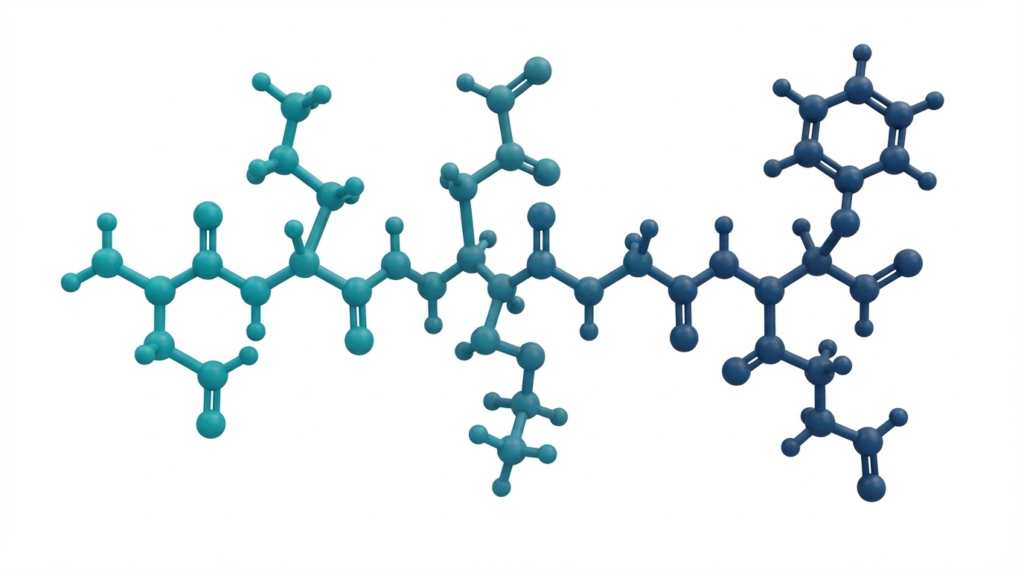
Research peptides are synthetic amino acid chains – typically 2 to 50 residues in length – produced under controlled conditions to defined sequence and purity specifications, and classified as Research Use Only (RUO) compounds for exclusive use in in vitro scientific investigation.
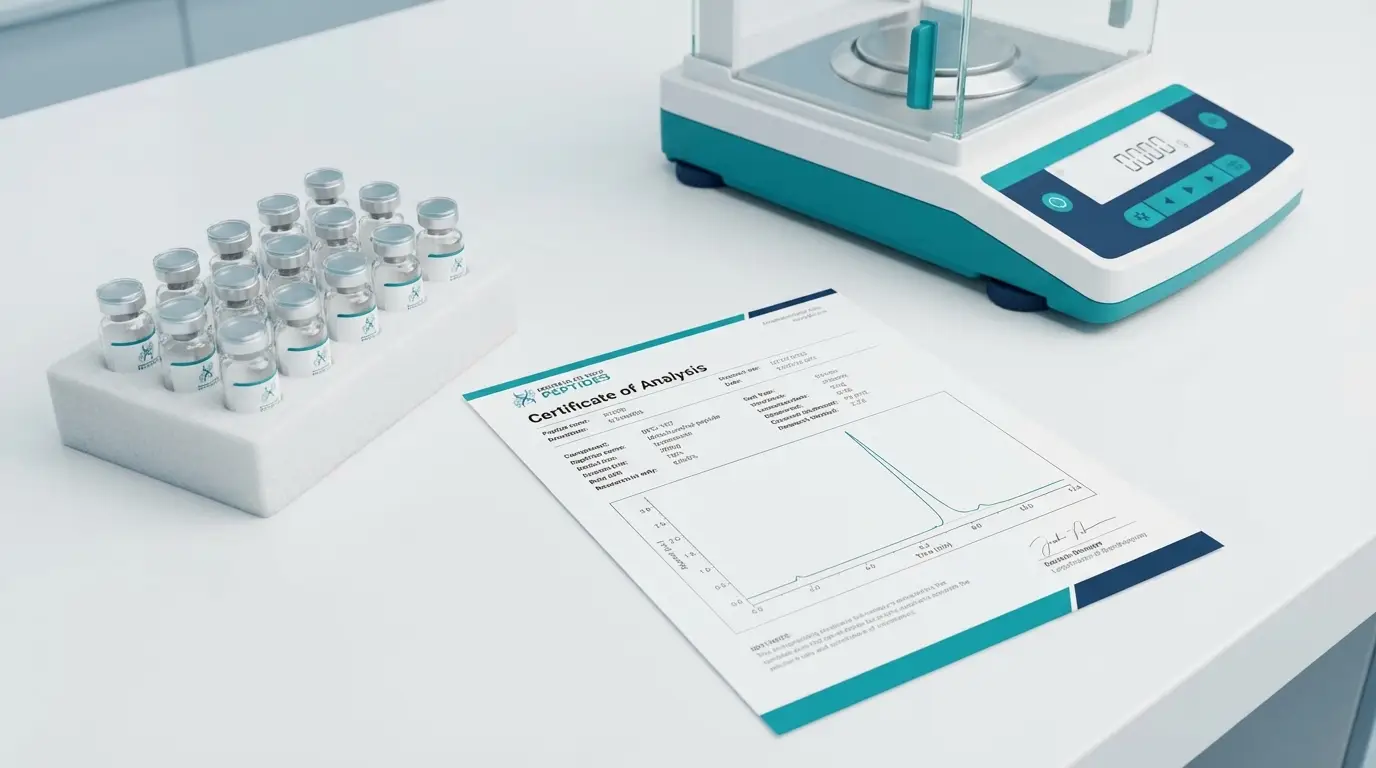
Each research-grade peptide batch arrives with three defining documents: a verified amino acid sequence, a mass-spectrometry-confirmed molecular weight, and an HPLC-verified purity certificate. These parameters make a synthetic research peptide reproducible, traceable, and suitable for quantitative laboratory work – properties that distinguish it from every other peptide category.
The scientific literature documents synthetic peptides as molecular tools across receptor binding studies, enzyme kinetics, signal transduction pathway research, and structural biology. [3] The breadth of published applications reflects one defining advantage: a research peptide is a chemically defined probe. Investigators know exactly what they are working with at the atomic level – something impossible to guarantee with biological extracts or consumer-grade compounds.
All research peptides sold by Molecular Edge Peptides are classified for in vitro laboratory use only. They are not intended for human or animal consumption in any form.
How Do Research Peptides Differ from Dietary Supplements?
The difference between research peptides and dietary supplements is regulatory and absolute – not a matter of chemistry, but of legal classification, intended use, and documentation standard.
The same amino acid sequence can theoretically exist in both categories. What changes is everything surrounding it: who it is sold to, under what legal framework, with what documentation, and for what purpose.
Dietary supplements fall under the Dietary Supplement Health and Education Act (DSHEA). Manufacturers target consumers, label serving sizes, and may make permissible structure/function claims. Purity documentation is not mandated at the federal level.
Research peptides operate under a Research Use Only (RUO) designation. Every batch ships with a Certificate of Analysis documenting HPLC-verified purity percentage and mass spectrometry identity confirmation. No dosing guidance is provided – because dosing guidance has no relevance to in vitro laboratory research.
| Characteristic | Research Peptides | Dietary Supplements |
|---|---|---|
| Regulatory Framework | Research Use Only (RUO) | DSHEA |
| Intended Use | In vitro laboratory research | Human consumption |
| Purity Standard | >95-99% – HPLC verified | Variable – no federal mandate |
| Quality Documentation | CoA with HPLC + mass spec required | Not universally required |
| Dosing Information | None – not applicable | Labeled serving size |
| FDA Drug Approval | Not approved for any clinical use | Not approved as drugs |
| Sold to | Qualified research laboratories | General consumer |
This table is not a technical footnote. The RUO classification defines the entire research peptide supply chain – from manufacturing specifications to the language a supplier can legally use when describing a compound.
What Does Research Use Only (RUO) Classification Actually Mean?
RUO – Research Use Only – confirms that a compound has not entered the FDA clinical approval process for any therapeutic, diagnostic, or consumer application, and is intended strictly for controlled laboratory research.
The designation creates a clear three-tier structure in the compound supply chain: research-grade (RUO), clinical-grade (IND/approved), and consumer-grade (DSHEA supplement). Research peptides belong exclusively to the first tier. They are research tools – not treatments, not supplements, not finished pharmaceutical products.
For research laboratories – academic institutions, pharmaceutical R&D departments, independent research organizations – RUO classification defines the institutional framework under which these compounds are handled, stored, and used experimentally.
For suppliers, RUO classification carries four specific obligations:
- Manufacturing to defined purity specifications (>99% for research-grade)
- Providing full Certificate of Analysis documentation with every batch
- Refraining from providing usage instructions, dosing guidance, or clinical language of any kind
- Labeling all products clearly: “For in vitro research use only – not for human or animal consumption”
Scientific literature confirms that research-grade synthetic peptides now serve as fundamental investigational tools across preclinical pharmacology, biochemistry, and molecular biology research. [3] [5] The RUO framework makes this research possible while maintaining a clear legal and ethical boundary that both suppliers and researchers are obligated to respect.
How Are Research-Grade Peptides Synthesized?
Research-grade peptides are produced by Solid-Phase Peptide Synthesis (SPPS) – a method invented by Robert Merrifield in 1963 that builds amino acid sequences stepwise on an insoluble solid resin support. [1]
SPPS solved the core challenge of peptide chemistry: as chain length grows, solution-phase synthesis yields collapse and purification becomes intractable. Merrifield’s approach anchors the growing chain to a solid support, allowing excess reagents and byproducts to be washed away after each coupling step – making long, complex sequences practical to synthesize reproducibly. [1]
The Fmoc (9-fluorenylmethoxycarbonyl) SPPS strategy, introduced by Fields and Noble, became the industry standard for research peptide production. [2] Fmoc chemistry uses base-labile protecting groups on each incoming amino acid’s alpha-amine, enabling mild deprotection conditions compatible with a wide range of side-chain functionalities. [2]
Following chain assembly, the peptide undergoes three critical steps:
- Cleavage from the resin support under acidic conditions
- Reverse-phase HPLC purification – separating the target sequence from truncated chains, deletion products, and synthesis byproducts [2]
- Lyophilization (freeze-drying) to produce the stable white powder that ships with every research batch
Mass spectrometry then confirms molecular identity by matching the observed [M+H]+ ion to the theoretical molecular weight of the target sequence – and these results are compiled into the Certificate of Analysis that accompanies every order.
What Does Greater Than 99% Purity Mean for In Vitro Research?
A purity specification of >99% means 99% or more of the measured mass is the target peptide sequence – with less than 1% consisting of truncated sequences, deletion products, synthesis byproducts, or residual solvents. [2]
For in vitro research, this is not a marketing number. It has three direct experimental consequences:
1. Result validity. Impurities are not chemically inert. A deletion product – a peptide missing a single residue – can bind the same receptor as the target compound and produce an independent biological signal. At >99% purity, this confound is negligible in well-designed assays.
2. Concentration accuracy. Calculating active compound concentration in a research solution requires knowing the exact purity fraction of the starting material. A peptide at 80% purity delivers only 80% of the expected molar quantity per measured weight – a systematic error embedded in every concentration-dependent experiment.
3. Inter-laboratory reproducibility. Published results are reproducible only when compound identity and purity are independently verifiable. CoA documentation is what allows a research group in one institution to replicate an assay design from another using the same compound specification.
HPLC purity is reported as the area percentage of the target compound peak in the chromatogram. A >99% result corresponds to a single dominant peak occupying more than 99% of total chromatographic area. Mass spectrometry then confirms identity by matching the observed molecular ion to the theoretical molecular weight.
For a full technical walkthrough of interpreting HPLC chromatograms and mass spectrometry data on a Certificate of Analysis, see the Molecular Edge guide to interpreting HPLC and mass spectrometry in peptide research.

Why Do Research Laboratories Choose Synthetic Peptides?
Synthetic research peptides offer four properties that biological extracts and recombinant proteins cannot reliably match: sequence precision, batch consistency, pharmaceutical research relevance, and catalog accessibility.
Sequence precision. A synthetic peptide is defined at the atomic level. A researcher can isolate a 10-residue receptor-binding domain, study it in isolation, substitute a single residue, and directly measure the binding affinity change. This resolution is structurally impossible with full-length proteins or biological extracts.
Batch consistency. Chemical synthesis under defined conditions produces the same compound every time. Receptor binding kinetics studies are reproducible across independent research groups precisely because synthetic peptide lots are chemically identical in a way that biologically derived preparations cannot guarantee. [3]
Pharmaceutical research relevance. Scientific literature documents hundreds of peptide-derived molecules across the drug development pipeline at various preclinical and clinical stages. [4] Synthetic research peptides are the primary investigational tools used to establish mechanism, selectivity, and structure-activity relationships before any compound advances further. [4] [6] Widely studied examples in published literature include BPC-157, examined across multiple tissue and receptor model systems, and available as research-grade BPC-157 for qualified laboratory use.
Catalog accessibility. The research-grade synthetic peptide supply market has expanded significantly over two decades, making a broad range of compounds – from GHRH analogs to longevity-associated tetrapeptides – accessible with documented quality standards. [5]
For researchers preparing synthetic peptides in solution prior to assay use, proper reconstitution requires pharmaceutical-grade sterile diluent. Bacteriostatic water for peptide reconstitution is the standard diluent used in published in vitro protocols requiring multi-day solution stability. The Molecular Edge precision reconstitution guide covers preparation methods consistent with laboratory protocols in the published literature.
Research Peptide Specifications: Standard vs. Research Grade
| Specification | Standard Grade | Research Grade (>99%) |
|---|---|---|
| Typical Purity | 70-85% | >95-99% |
| HPLC Chromatogram | Rarely provided | Standard – every batch |
| Mass Spectrometry Confirmation | Uncommon | Standard |
| Full Sequence Verification | Limited | Confirmed |
| Lyophilized Format | Variable | Standard |
| Suitable for Quantitative In Vitro Assays | Unreliable | Yes |
| Lot-to-Lot Consistency | Variable | High |
| Certificate of Analysis | Not standard | Required |
| Suitable for Publication-Grade Research | No | Yes |
Molecular Edge Peptides supplies a research-grade synthetic peptide catalog manufactured to >99% purity with full Certificate of Analysis documentation – HPLC chromatogram and mass spectrometry data included – for qualified in vitro laboratory research use exclusively.
Frequently Asked Questions
What are research peptides used for in a laboratory setting?
Research peptides are molecular tools used in controlled in vitro investigations. Published studies examine their interactions with specific receptors, enzymes, and cellular signaling pathways across biochemistry, pharmacology, and molecular biology. They carry a Research Use Only (RUO) classification – their application is strictly limited to laboratory research environments and does not extend to human or animal use of any kind.
Are research peptides the same as peptide supplements?
No. Research peptides and peptide supplements differ fundamentally in regulatory classification, intended use, and documentation standards. Research peptides are RUO-classified compounds manufactured for in vitro laboratory use only – not for ingestion. Dietary supplements are DSHEA-regulated consumer products. The same amino acid sequence can theoretically exist in both categories, but its regulatory status, purity documentation requirements, and legal framework are entirely distinct.
What does RUO mean on a peptide product?
RUO stands for Research Use Only. It is a regulatory designation confirming that a compound has not been evaluated or approved by the FDA for any therapeutic, diagnostic, or consumer application, and is intended exclusively for controlled laboratory research. Suppliers of RUO compounds are prohibited from providing usage instructions or dosing guidance of any kind.
Why does purity percentage matter when selecting research peptides?
Purity directly determines experimental validity. Impurities – including truncated sequences and deletion products – can independently interact with receptors or assay systems, producing confounded results. At >99% purity, less than 1% of the material is non-target, minimizing this risk. Purity also determines concentration accuracy: a peptide at 80% purity delivers only 80% of the expected active compound per measured mass. [2]
How are research-grade peptides made?
Research-grade peptides are synthesized by Solid-Phase Peptide Synthesis (SPPS), invented by Merrifield in 1963. [1] The Fmoc SPPS strategy assembles the amino acid sequence stepwise on a solid resin support, then the completed chain is cleaved, purified by reverse-phase HPLC, lyophilized, and confirmed by mass spectrometry. [2] The results are documented in a Certificate of Analysis shipped with every batch.
Where can I find research protocols and standards for working with synthetic peptides?
The Molecular Edge 2026 Master Index of Peptide Research Protocols provides a reference hub for current research standards, protocol frameworks, and technical guides across the synthetic peptide field. For solution preparation specifically, the peptide reconstitution technical guide covers laboratory preparation methods consistent with published in vitro protocols.
Disclaimer: All products sold by Molecular Edge Peptides are strictly intended for laboratory research use only (in vitro). They are not approved for human or animal consumption, or for any form of therapeutic, diagnostic, or clinical use. The information in this article is for educational and scientific reference purposes only. We do not provide usage instructions, dosing guidelines, or any advice regarding personal application of our products. Always consult relevant regulatory frameworks before conducting research with these compounds.
References
- Merrifield RB. “Solid Phase Peptide Synthesis. I. The Synthesis of a Tetrapeptide.” J Am Chem Soc. 1963;85(14):2149-2154. https://doi.org/10.1021/ja00896a072
- Fields GB, Noble RL. “Solid phase peptide synthesis utilizing 9-fluorenylmethoxycarbonyl amino acids.” Int J Pept Protein Res. 1990;35(3):161-214. https://pubmed.ncbi.nlm.nih.gov/2191922/
- Fosgerau K, Hoffmann T. “Peptide therapeutics: current status and future directions.” Drug Discov Today. 2015;20(1):122-128. https://pubmed.ncbi.nlm.nih.gov/25450771/
- Albericio F, Kruger HG. “Therapeutic peptides.” Future Med Chem. 2012;4(12):1527-1531. https://pubmed.ncbi.nlm.nih.gov/22917241/
- Vlieghe P, Lisowski V, Martinez J, Khrestchatisky M. “Synthetic therapeutic peptides: science and market.” Drug Discov Today. 2010;15(1-2):40-56. https://pubmed.ncbi.nlm.nih.gov/19879957/
- Craik DJ, Fairlie DP, Liras S, Price D. “The future of peptide-based drugs.” Chem Biol Drug Des. 2013;81(1):136-147. https://pubmed.ncbi.nlm.nih.gov/23253135/