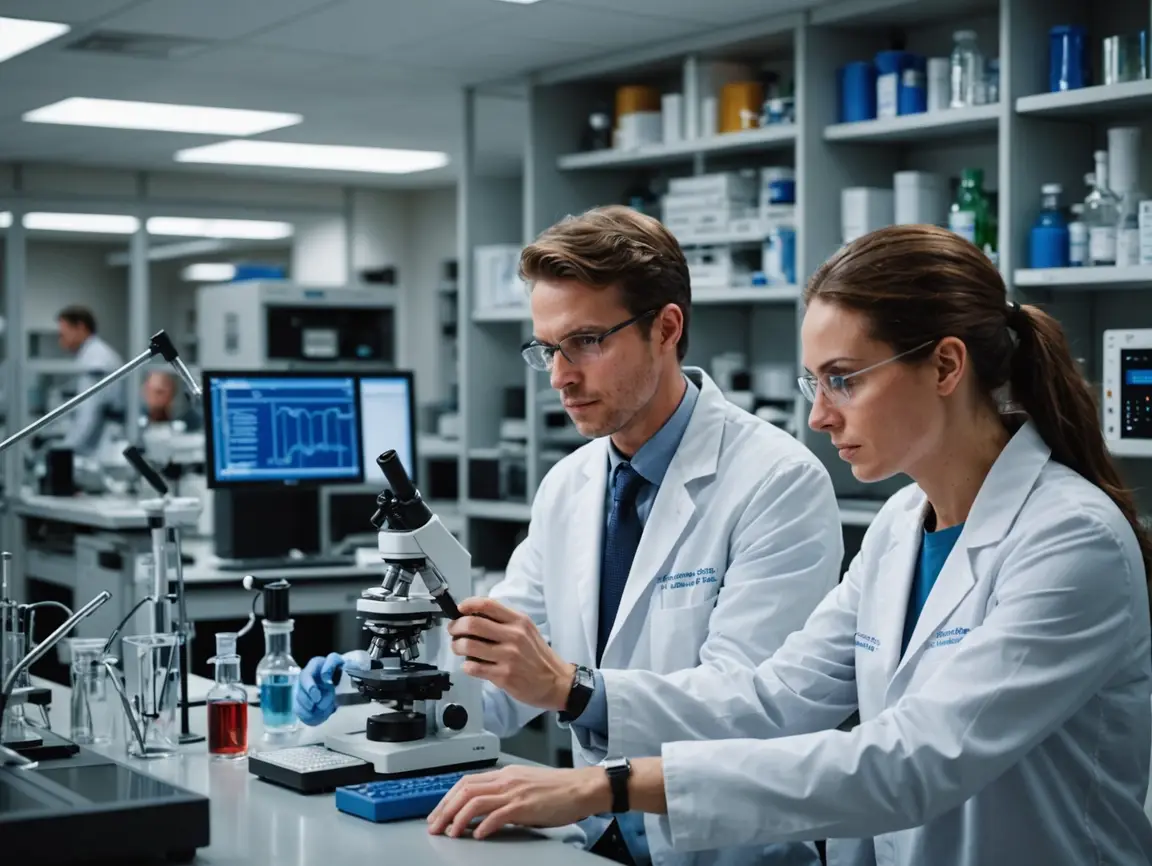
In modern proteomics, precision is the difference between a breakthrough and a failed assay. This Master Index serves as a centralized resource for researchers navigating the complexities of peptide synthesis, storage, and specialized signaling pathways.
Whether you are investigating metabolic agonists or neurological plasticity, use this guide as your roadmap for standardizing laboratory protocols and selecting the highest-purity research reagents.
Laboratory Compliance Statement
All compounds referenced in this index are intended strictly for in-vitro laboratory research. These materials are not for human or animal consumption and have not been evaluated by the FDA for clinical use. Molecular Edge Peptides provides these reagents exclusively for professional scientific investigation.
Section 1: General Laboratory Protocols & Compliance
Before commencing any study, establishing a baseline for reagent integrity is paramount. This section covers the foundational physics and chemistry of peptide handling.
- Storage & Stability: Learn about the degradation thresholds of amino acid chains and why -20°C is the gold standard for lyophilized preservation. [Read Full Article: Peptide Storage & Stability Guide]
- Reconstitution Science: A technical look at molarity calculations and why solvents like Bacteriostatic Water are preferred for maintaining solution sterility. [Read Full Article: Reconstitution Protocols]
- Quality Control: How to interpret HPLC and Mass Spectrometry reports to verify 99%+ purity. [Read Full Article: Understanding COAs & Purity]
Section 2: Tissue Repair & Bioremediation Hub
This research niche focuses on peptides that modulate the extracellular matrix and systemic inflammatory responses.
- Angiogenesis & Healing: The study of BPC-157 and its interaction with the nitric oxide pathway to simulate tissue repair. [Read Full Article: BPC-157]
- Actin Upregulation: How TB-500 (Thymosin Beta-4) influences cellular migration in connective tissue models. [Read Full Article: TB-500]
- Synergistic Protocols: Researching the “stacking” of BPC-157 and GHK-Cu for collagen synthesis studies. [Explore the Bioremediation Hub]
Section 3: Cognitive & Neurological Hub
The study of the “Brain-Peptide Axis” requires sequences capable of modulating neurotransmitter balance and crossing the blood-brain barrier.
- Neurogenesis & Plasticity: Investigative study into Semax and Cerebrolysin for their BDNF-upregulating properties. [Read Full Article: Study into Semax and Cerebrolysin]
- Anxiolytic Modeling: The GABAergic influence of Selank in neural tissue assays.
- BBB Permeability: Scientific analysis of which peptide sequences effectively penetrate the blood-brain barrier. [Explore the Neurological Hub]
Section 4: Somatotropic (Growth) Research Hub
This section details the peptides involved in pituitary signaling and the modulation of the somatotropic axis.
- Pituitary Signaling: Comparative analysis of GHRPs (Ipamorelin) and GHRHs (CJC-1295) on growth hormone amplitude.
- Half-Life Extensions: Research into the Drug Affinity Complex (DAC) and its role in prolonging sequence stability.
- Tissue Density: Exploring the binding affinities of IGF-1 LR3 vs. IGF-1 DES. [Explore the Somatotropic Hub]