
In the ever-evolving world of health and beauty, few ingredients have garnered as much attention as peptides and collagen. Often mentioned in the same breath, these two compounds are intrinsically linked, playing a pivotal role in maintaining the structure, elasticity, and overall youthfulness of our skin and connective tissues. From anti-aging creams to dietary supplements for joint pain, their presence is ubiquitous. But what exactly are they, how do they work together, and what does science say about their benefits? This article delves deep into the science of peptides and collagen, exploring their synergistic relationship and their proven benefits.
What is Collagen? The Body’s Structural Scaffolding
Collagen is the most abundant protein in the human body, accounting for approximately 30% of its total protein content. It acts as the primary structural component of connective tissues, including skin, tendons, ligaments, cartilage, and bone. You can think of collagen as the “glue” that holds everything together, providing strength, structure, and elasticity.
There are at least 28 different types of collagen, but the most common are:
- Type I: The most abundant type, found in skin, tendons, internal organs, and the organic parts of bone. It is crucial for skin strength and elasticity.
- Type II: The primary component of cartilage, essential for joint health and cushioning.
- Type III: Found alongside Type I in skin, muscles, and blood vessels. It plays a role in the early stages of wound repair.
As we age, our body’s natural collagen production declines. This process begins in our mid-20s and accelerates with factors like UV exposure, smoking, and a high-sugar diet. The visible signs of this decline include wrinkles, sagging skin, and stiffer joints. This inevitable natural loss has fueled the immense popularity of collagen supplements, which are projected to reach a market value of $1.22 billion by 2030 [1].
What are Peptides? The Building Blocks and Signalers
Peptides are short chains of amino acids, typically comprising two to fifty amino acids linked by peptide bonds. They are the building blocks of proteins like collagen, elastin, and keratin. While proteins are long, complex, folded molecules, peptides are smaller and more easily absorbed by the body.
Peptides are not just passive building blocks; they are also potent bioactive molecules. They act as signaling agents in the body, instructing cells to perform specific functions. For instance, certain peptides can signal skin cells to produce more collagen or hyaluronic acid, which is why they are a staple in anti-aging skincare. Their small size allows them to penetrate the skin’s barrier more effectively than larger protein molecules.
The Synergy: How Peptides Boost Collagen Production
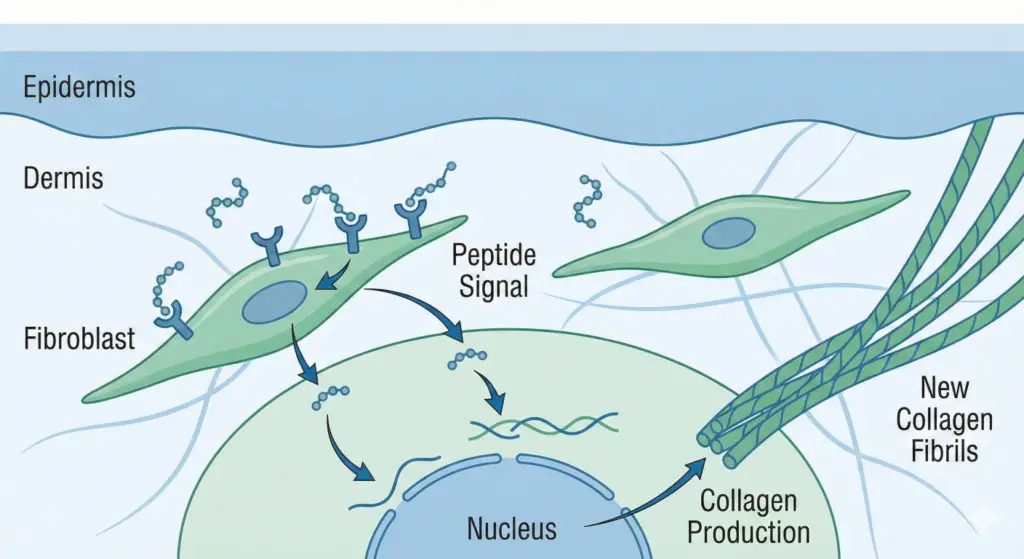
The relationship between peptides and collagen is synergistic. When you consume collagen, your digestive system breaks it down into smaller peptides and amino acids. These are then absorbed into the bloodstream and distributed throughout the body. The presence of these specific peptides, particularly those containing hydroxyproline, acts as a signal to fibroblasts – the specialized cells in the dermis responsible for synthesizing collagen.
Think of fibroblasts as collagen factories and peptides as the foremen that give the order to increase production. By providing both the raw materials (amino acids) and the signal to start building, collagen peptides effectively stimulate the body’s own collagen synthesis process. This mechanism is supported by scientific research, which has shown that specific collagen-derived peptides can survive digestion and stimulate skin fibroblast growth and hyaluronic acid production [7].
Scientific Evidence: Benefits for Skin and Joints
The growing popularity of collagen peptides is backed by an increasing body of scientific evidence demonstrating their benefits, particularly for skin and joint health.
Skin Health, Hydration, and Anti-Aging
Numerous studies have investigated the effects of oral collagen peptide supplementation on skin parameters. A randomized, double-blind, placebo-controlled trial found that supplementation with low-molecular-weight collagen peptides significantly improved skin hydration, elasticity, and wrinkling in human skin [2]. Another review of the literature confirmed that hydrolyzed collagen supplementation promotes beneficial skin changes, including decreased wrinkle formation, increased skin elasticity, and increased hydration [3]. The mechanism involves not just providing building blocks but also stimulating the synthesis of new collagen and other extracellular matrix components like elastin and glycosaminoglycans.
Joint and Bone Health
Beyond skin, collagen peptides show promise for supporting joint and bone health. Collagen is a major component of cartilage, and its degradation is a key feature of conditions like osteoarthritis. Studies suggest that collagen peptides can increase bone strength and density, improve joint mobility, and reduce pain associated with activity and aging [3]. They help by stimulating chondrocytes (cartilage cells) to produce extracellular matrix components, potentially slowing down cartilage degeneration and supporting joint comfort.
Choosing the Right Collagen Peptide Product
For those interested in the legitimate benefits of collagen, choosing a high-quality product is key. Look for “hydrolyzed collagen” or “collagen peptides,” which means the collagen has been broken down into smaller, more absorbable peptide chains. Products sourced from grass-fed, pasture-raised bovine or wild-caught marine sources are often preferred for their quality. Third-party testing by independent organizations can also provide assurance of a product’s purity and potency.
References
[1] “Collagen Peptides Market Size, Trends, Share, Forecast By 2030,” Allied Market Research. Available at: https://www.alliedmarketresearch.com/collagen-peptides-market-A17232
[2] Kim DU, Chung HC, Choi J, Sakai Y, Lee BY. “Oral Intake of Low-Molecular-Weight Collagen Peptide Improves Hydration, Elasticity, and Wrinkling in Human Skin: A Randomized, Double-Blind, Placebo-Controlled Study,” Nutrients. 2018; 10(7):826. Available at: https://pmc.ncbi.nlm.nih.gov/articles/PMC6073484/
[3] De Luca, C., Mikhal’chik, E. V., Suprun, M. V., Papacharalambous, M., Truhan, A. I., & Korkina, L. G. (2016). “Skin Antiageing and Systemic Redox Effects of Supplementation with Marine Collagen Peptides and Plant-Derived Antioxidants: A Single-Blind Case-Control Clinical Study,” Oxidative medicine and cellular longevity, 2016, 4389410. Available at: https://pmc.ncbi.nlm.nih.gov/articles/PMC10102402/
[4] “What are research grade peptides used for?,” Bachem FAQ. Available at: https://www.bachem.com/helpie_faq/what-are-research-grade-peptides-used-for/#:~:text=Research%20grade%20peptides%20are%20intended,for%20human%20or%20animal%20consumption.
[5] “What are research grade peptides used for?,” Bachem FAQ. Available at: https://www.bachem.com/helpie_faq/what-are-research-grade-peptides-used-for/
[6] “Buyer Beware: Why “Research Peptides” Are a Dangerous Health Risk,” Charleston HealthSpan Institute. Available at: https://charlestonhealthspan.com/buyer-beware-why-research-peptides-are-a-dangerous-health-risk/
[7] “Collagen Peptides: Production, Bioactivities, and Mechanism of Actions,” Frontiers in Nutrition. Available at: https://www.frontiersin.org/research-topics/59508/collagen-peptides-production-bioactivities-and-mechanism-of-actions